Zeiss Evo 50 Scanning Electron Microscope
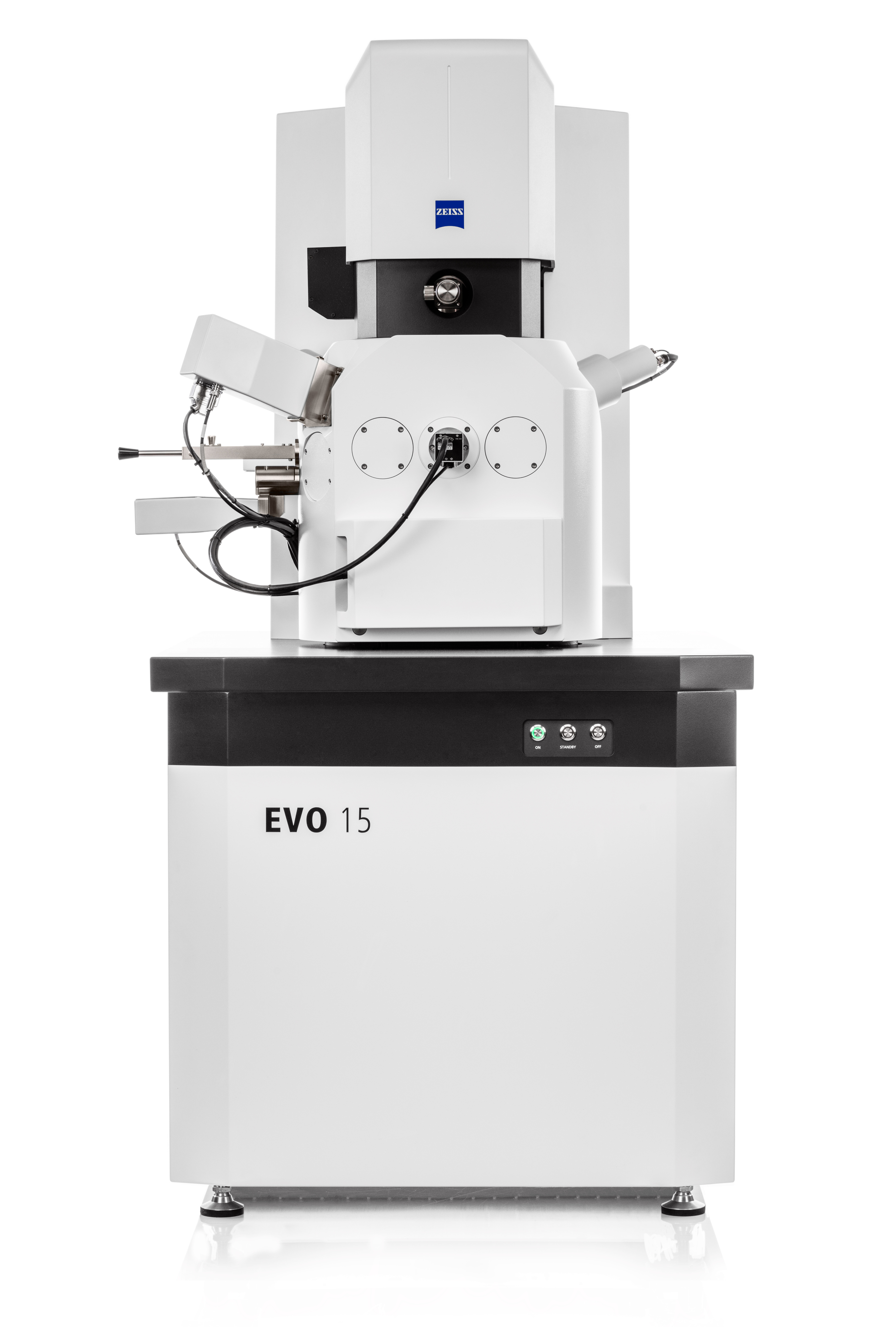
Zeiss EVO MA 15 Scanning Electron MicroscopeZeiss EVO MA 15 Scanning Electron MicroscopeThe IQ center features a Zeiss EVO 15 Scanning Electron Microscope. This is a flexible variable pressure SEM with wide range of detectors and analysis software. Sample prep is supported with a Cressington gold sputter coater and a Leica carbon coater.
SEM OverviewScanning Electron Microscopes use electrons instead of light to illuminate samples. Because electrons have much shorter wavelengths than light, much higher magnification is possible. The process of forming and image in the electron microscope starts by creating electrons using an electron gun. The electrons are then focused into a narrow beam using a series of magnetic lenses.
ZEISS presents the new generation of its proven high performance scanning electron microscope (SEM): The new instruments of the ZEISS EVO family come with a variety of improvements regarding usability, image quality and seamless integration into multimodal workflows. Electron Microscopes (EM) can provide image resolution at nanometer scale and permit imaging of complex substance and biological specimens. Scanning EM (SEM) can provide details on surface topology, whereas transmission EM (TEM) can capture atomic-level subsurface details through thinly sliced samples. When shopping, important considerations include: the type, size, and possible edge effects. Scanning Electron Microscopes. Hitachi S-4300 Features. Filament Type: Cold-cathode field emission. Detectors: SE/BSE/EBSD. Zeiss EVO MA 10 Features. Filament Type: Tungsten. Detectors: SE/VPSE (environmental)/BSE/EDX. Electron Microscopy Center University of Kentucky - ASTeCC Building145 Graham Avenue Lexington, KY.
To form an image the beam is scanned across a sample in a grid pattern and detectors record what comes from the sample.When the electron beam from the SEM strikes the sample it generates many electrons and electromagnetic radiation including X-Rays. The type of detector used determines what the image looks like and what it is telling you. The SEM in the IQ center is outfitted with several detectors.Secondary electrons are electrons that are ejected from the outer shells of the sample through inelastic collisions with the electron beam. Because these electrons are the most numerous and they are generated close to the surface of the sample, they give the best image of the surface features of a sample. This is the most common type of detector and unless it is otherwise stated on an image it has probably been produced with secondary electrons.The Zeiss SEM in the IQ center is also outfitted with a backscatter detector. Backscattered electrons are electrons from the SEM beam that have interacted with the sample atoms and have escaped. This process occurs deeper in the sample, so surface details are not as clear with this detector.
However, it can provide other useful information - the number of backscatter electrons is proportional to the atomic number of the sample. The higher the atomic number the more backscattered electrons, which corresponds to a brighter image. TrainingInformation on how to get trained on the SEM can be found.
StereomicroscopyClick to learn how to create 3D images using the SEM.
Zeiss EVO MA 15 Scanning Electron MicroscopeZeiss EVO MA 15 Scanning Electron MicroscopeThe IQ center features a Zeiss EVO 15 Scanning Electron Microscope. This is a flexible variable pressure SEM with wide range of detectors and analysis software. Sample prep is supported with a Cressington gold sputter coater and a Leica carbon coater. SEM OverviewScanning Electron Microscopes use electrons instead of light to illuminate samples.
Because electrons have much shorter wavelengths than light, much higher magnification is possible. The process of forming and image in the electron microscope starts by creating electrons using an electron gun. The electrons are then focused into a narrow beam using a series of magnetic lenses.
Zeiss Scanning Electron Microscope
To form an image the beam is scanned across a sample in a grid pattern and detectors record what comes from the sample.When the electron beam from the SEM strikes the sample it generates many electrons and electromagnetic radiation including X-Rays. The type of detector used determines what the image looks like and what it is telling you. The SEM in the IQ center is outfitted with several detectors.Secondary electrons are electrons that are ejected from the outer shells of the sample through inelastic collisions with the electron beam. Because these electrons are the most numerous and they are generated close to the surface of the sample, they give the best image of the surface features of a sample. This is the most common type of detector and unless it is otherwise stated on an image it has probably been produced with secondary electrons.The Zeiss SEM in the IQ center is also outfitted with a backscatter detector. Backscattered electrons are electrons from the SEM beam that have interacted with the sample atoms and have escaped.
This process occurs deeper in the sample, so surface details are not as clear with this detector. However, it can provide other useful information - the number of backscatter electrons is proportional to the atomic number of the sample. The higher the atomic number the more backscattered electrons, which corresponds to a brighter image.
TrainingInformation on how to get trained on the SEM can be found. StereomicroscopyClick to learn how to create 3D images using the SEM.